
Autonomous drones and ground robots raced alongside first responders this week to triage simulated mass casualty incidents, spotting faux-but-lifelike life-threatening injuries and relaying critical data to human medics. The scenarios were part of the DARPA Triage Challenge, which the Texas A&M Engineering Extension Service, or TEEX, staged from Thursday, Nov. 5 through Friday, Nov. 13, at Disaster City® in College Station. As hundreds of researchers, medics, support staff and investors looked on, more than 100 participants from the U.S. military, universities, tech companies and startups competed for over $3 million in cash prizes. Each team aimed to build technology that helps military and civilian responders triage casualties quickly, accurately and at scale when medical resources are stretched thin and every minute spent on triage can mean a life saved.
DARPA, or the Defense Advanced Research Projects Agency, is the Department of War’s research and development agency responsible for creating breakthrough technologies for national security. Several innovations we use every day, including the internet and GPS technology small enough to fit in a phone, came directly from DARPA research.

(DARPA is the Defense Advanced Research Projects Agency and created the DARPA Triage Challenge in 2023.)
TEEX’s community of experts and unique facilities were a natural fit to showcase DARPA’s Triage Challenge Finals. The agency employs hundreds of specialists in emergency response and safety and runs Disaster City®, a 52-acre mock community with full-scale structures that can collapse, rubble piles, a derailed train and more to simulate realistic disaster response in a simulated and safe environment. For retired U.S. Army Col. and physician Jeremy Pamplin, program manager for the DARPA Triage Challenge, choosing TEEX was an easy decision.
“To do a project of this size, scale and detail, TEEX just makes sense, bringing the DARPA Triage Challenge Finals to Disaster City,” Pamplin said. “We did this challenge to be the most realistic, repeatable and rigorous testbed for assessing medical technologies ever created, so all the hands-on logistics and work TEEX has done helped make that possible.”

The DARPA Triage Challenge is a prize-winning competition run by DARPA’s Biological Technologies Office to improve medical triage after mass casualty incidents. Teams are graded by DARPA’s command post, where state-of-the-art computing technology checks every mock casualty report against each patient’s simulated injuries and vital signs. Scoring runs over the course of five competitions, challenging competitors use the technology their teams developed to find the faux casualties, triage them, assess their realistic yet imitative injuries, read vital signs from a distance and work alongside human medics for faster — thus more effective — triage. Each of the five competitions was unique, including a simulated tornado ripping through a community market, smoke-filled buildings, nighttime searches in near darkness and search and rescue under piles of rubble. How each team performed in each competition added to its point total, which by the final day determined which teams advanced to the championship round, where the top two competed for the $1.5 million grand prize. Representatives from academic research institutions like the University of Pennsylvania, Carnegie Mellon University and the University of Maryland, as well as several private companies, traveled to TEEX for the final challenge.

Some teams paid their own way through every stage of the competition to reach the finals. One of the few self-funded teams was DRONE, short for Disaster Response Observation Network for Emergencies, based in Hawaii. The team has just two full-time members, Dr. Bob Nakata and his daughter, Angelina, a sophomore computer science student at Northeastern University. The father-daughter combo staved off tough competition from major research conglomerates to place second during the first trials of the competition. When asked what reaching the finals meant to their family, Nakata answered with honesty and a bit of humor.

“To me, this is being able to see my academic research become material and lifesaving,” Nakata said. “For my daughter, she has already gotten two or three job offers, and to see her foot get in the door through this has been worth all the hard work. Also, the prize money wouldn’t hurt to pay for Angelina’s college tuition.”
Nakata was one of many researchers at the event showing off new work to advance medical and emergency response technology. Along with the final competitions, the event featured an expo where public and private organizations shared the latest medical and lifesaving technology.
“TEEX is extremely grateful to help bring the finals of the DARPA Triage Challenge to life here, and working with such an important agency for American innovation, research and defense is a perfect fit for the kind of subject matter experts and facilities we have at our agency,” said Ray Ivie, director of the TEEX Office of Research. “This was a multi-month planning process, and to see the kinds of cutting-edge emergency response technology being tested at TEEX shows how dedicated our agency is to saving lives.”

Ivie worked closely with program manager Pamplin to account for every logistical possibility, turning event planning into a precise science.
Actors playing civilians in the challenge, for example, moved through nearly a dozen preparation stations, each timed within a few minutes. The tight schedule put the right people in the right place at exactly the right time for every competition scenario, keeping each simulation as realistic and precise as possible.
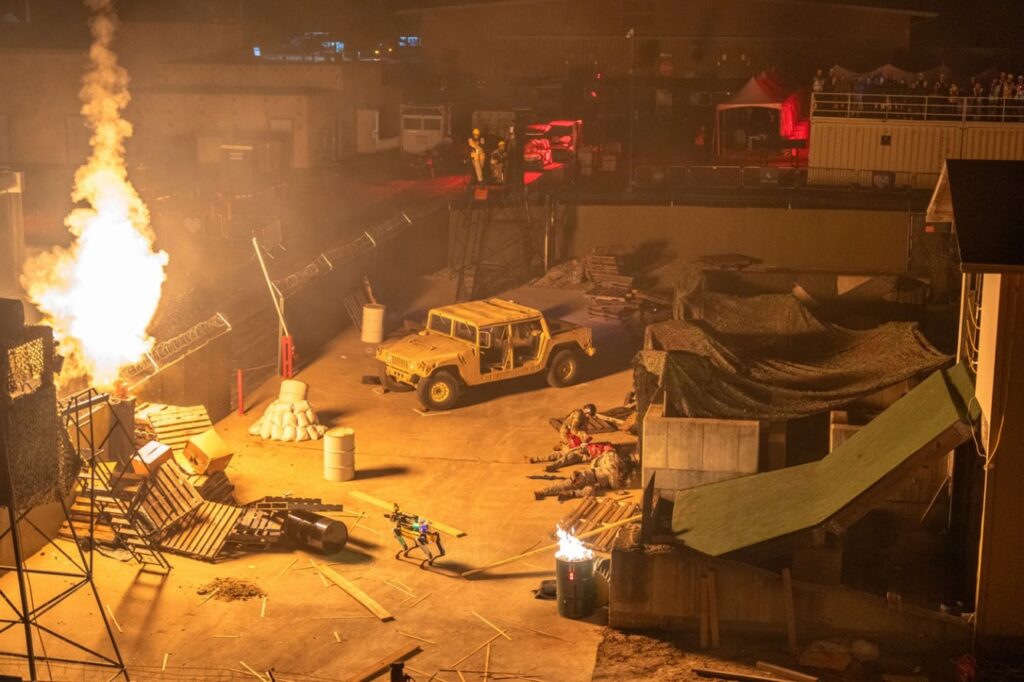
“The first five stations, which include getting your individualized script and itinerary, changing into clothes we provide, and detailed safety instructions for the day, take about 15 minutes, with time for actors to review their scripts before they got to makeup,” said Richard Salve, chief operating officer at R2 Medical Group, who served as one of many actor coordinators for the event. “After that, we have it timed so that the remaining stations get the actors out onto their challenge stations extremely prepared and knowledgeable about what they’re going to do and when they’re going to do it, all to reinforce the safety of everyone and the realism of the exercise. Each station has dedicated team members who have also been trained to troubleshoot when a participant needs any kind of assistance. We really thought of everything in the planning process.”

Like Salve, Pamplin credits the realistic rigor of the exercise to the thoroughness of the event coordinators and workers. When asked what it was like to work with TEEX on such a massive event, Pamplin praised the agency’s support.
“All the problems we have had, TEEX has helped solve,” Pamplin said. “The environment was transformed overnight from TEEX’s daily activities to the DARPA Triage Challenge, and every step of the way they helped with planning and changing that infrastructure to put this event together. They have a lot of expertise, and they helped us a lot with scenario development to ensure this felt and looked as real as possible.”
To learn more about the DARPA Triage Challenge held at Disaster City®, and to view more video and images from the event, click the link here.
Distributed by:
Texas A&M Engineering Extension Service
Vita Vaughn | Director of Communications
[email protected]