
TEEX Extension Program Brings Lifesaving Expertise to Every Corner of the State
The day after deputies from the Delta County Sheriff’s Office completed a de-escalation course in Northeast Texas, the training was put to the test when a deputy responding to a 911 call encountered a teenager in a mental health crisis involving a knife. In a situation that could have turned violent, the deputy used the techniques they had learned less than 24 hours earlier, successfully talking the young person to safety.
Responding Delta County Chief Deputy Sheriff Alex Suarez said, “Having gone through this class and having been at the scene as the situation was unfolding, I can see the real value of peace officers attending this course,” said Suarez. “Prior to this class, the responding deputies would have probably tried to de-escalate for a few minutes but then would have gone hands-on and physically removed her from the home to the ambulance. The course gave many useful tools that deputies were able to use in a real-world situation.”
The de-escalation course was delivered by the Texas A&M Engineering Extension Service (TEEX) Extension Program, which was built for communities like Delta County. In rural, geographically remote communities in Texas, the people who respond to emergencies are often volunteers and small departments with tight budgets and no personnel to spare for a week of training hundreds of miles away.
“One of the unique things about the TEEX Extension Program is we’re going out to each tiny corner of Texas and bringing the training to them,” said TEEX Law Enforcement Extension Training Director Karl Kehrberg. They don’t have to travel to Bryan-College Station to learn. We meet them where the training is needed.”
Each year, the TEEX Extension Program trains more than 20,000 emergency responders across the state at little-to-no charge, providing training, subject matter expertise and technical assistance in firefighting, law enforcement and infrastructure. About 90 Extension Program personnel live and work throughout Texas, building relationships that carry training throughout the state and connect communities to vital resources when emergencies arise.
“We have people all over the state that are ready to help when help is needed most,” said TEEX Extension Program Director Darren Smith. “The TEEX Extension Program understands how to talk with people from and train in underserved places, and our people have relationships with the local community. We can get things done a lot faster because of those relationships.”
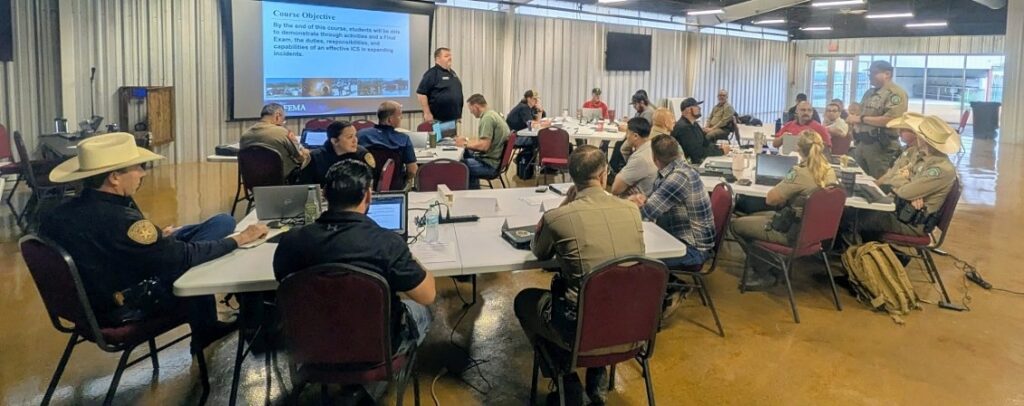
Relationships even make up some of the TEEX Extension Program’s training curriculum. The program delivers ICS 300 and 400 incident command course that prepares responders from every discipline, from public works to police, to operate under a unified command during a disaster in synergistic and cooperative ways.
Essential to incident command is fire and emergency response, which is also an essential tenet of the TEEX Extension Program. The goal of the Fire Extension Program is to provide exceptional, standard-based training to the State of Texas fire and emergency service personnel for the protection of life and property.
“Fire training brought by the Extension Program really does a good job growing the network of firefighters throughout the state,” said Smith. “We have a symposium in August where we bring in folks throughout Texas to learn about the Texas Intrastate Fire Mutual Aid System and managing emergency management grants.”
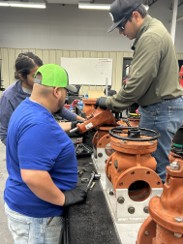
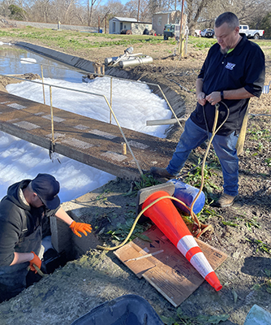
The TEEX Extension Program also facilitates keeping the water running in communities where personnel or expertise is scarce. Small rural water systems face high employee turnover, and Extension’s water outreach program travels to those communities to train and certify operators to the standards their systems require.
“When a system falls out of compliance or a treatment facility needs critical maintenance, we provide the technical assistance to get it back up to speed, sparing folks boil-water notices that can take a lot longer to fix,” said Smith. “That’s just one example of the real-world impact our training has, but there’s so much more.”
Distributed by:
Texas A&M Engineering Extension Service
Vita Vaughn | Director of Communications
[email protected]