
Breaking the Stigma: First responders find strength through TEEX peer support training

For Steven Ray, supporting first responders goes beyond the job; it’s personal. After experiencing and witnessing the mental toll that emergency response takes on firefighters, emergency medical technicians, law enforcement officers, paramedics and dispatchers, Ray wanted to build a support system within his department but needed guidance to begin. That desire led him to Support That Saves: A Guide to Building and Sustaining Peer Support, a Texas A&M Engineering Extension Service (TEEX) program designed to help first responder agencies and departments establish peer support teams and strengthen mental wellness.
As Division Chief of Health and Safety with Klein Fire Department, Ray was among the first to participate in this course when he attended the pilot in Rosenberg, Texas. He had always wanted to build a peer support team for his department, so the course offered the perfect opportunity.
“By the second or third module,” Ray says, “I was blown away.” After he took the course, he knew he wanted to get involved, so he hosted a course delivery in Houston. He enjoyed it so much that he applied and became a part-time instructor for the course.
Ray continues to work on building the Klein peer support team, and he says Support That Saves was instrumental in this work. “Without the class, I would have struggled to do it. The class definitely spearheaded everything and got us going in the right direction. It helped confirm that this is the right decision, and that it is going to be a major project that won’t happen overnight.”
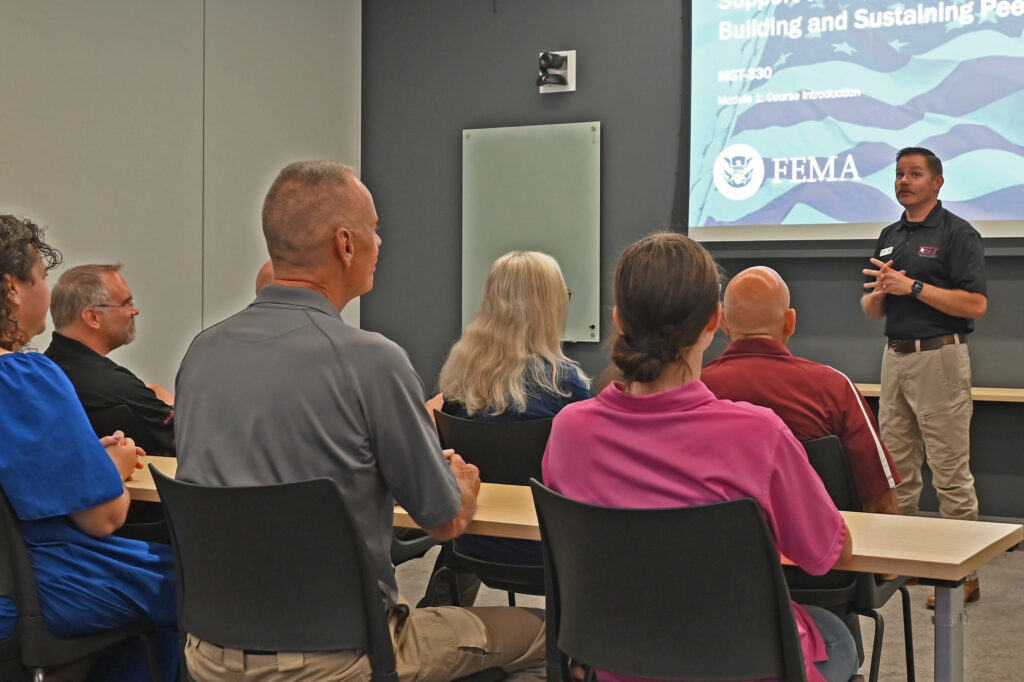
In addition to providing basic policies and procedures for team setup, the class exposes participants to professionals in other public safety disciplines. Ray says, “What’s eye-opening is when you get fire, EMS, law enforcement and dispatch all in the same room, it shows that it’s not just you, but it’s a global issue in all of our industries.” This breaks the stigma and helps participants understand the scope of the problem.
Ray describes the significance of TEEX offering these classes, saying, “A lot of departments over the years have talked about it, but there has never really been education that was pushed out about it unless you were a Licensed Professional Counselor. Having the backing of TEEX and FEMA, with their vetted instructors, goes a long way. TEEX delivers the course at no cost, which is life-changing for many people who are impacted by the course.”
According to the Substance Abuse and Mental Health Services Administration (SAMHSA), first responders face an elevated suicide risk compared to workers in other industries. As many as one in 10 first responders meet the criteria for post-traumatic stress disorder, which is nearly three times the rate of the general U.S. population. Compounding this crisis, police officers and firefighters are more likely to die by suicide than in the line of duty.
As a member of the first responder community, Ray has faced personal struggles as well, and he openly shares his story in an effort to help others. He carries two bullets with him; one was in his gun when he planned to attempt suicide, and the second was one he recovered from his partner’s gun when he responded to and interrupted their suicide attempt. These serve as daily reminders and conversation starters about the mental toll of the trauma experienced by first responders. His willingness to share his story allows others to open up about their struggles.
When asked why he’s so passionate about the course and sharing his story, Ray replies, “One, we have to work on ourselves. We’re not perfect. And two, we have to look out for each other. If I can save one person, I’ve made a difference.”
Distributed by:
Texas A&M Engineering Extension Service
Vita Vaughn | Director of Communications
[email protected]